



When we study a successful competitor, a natural question that comes to mind is, “What are they doing that we should also be doing?” At first glance, it is a very sensible starting point, but it can become misleading if we assume that the visible actions of a successful company are also the real reasons for its success.
This thought came to me while I was reading an interview with Mr. Hari Mohan Bangur, Chairman of Shree Cement, in Fortune India, September 2026. Mr. Bangur was asked whether brand-building generates a higher return than operational efficiency. What surprised me most was that, instead of arguing that one approach was superior, his response was essentially that both can be valid paths.
That simple observation raises an important strategy question: if two companies in the same industry are both performing well, are they necessarily winning for the same reason? Very often, they may not be.
Different Companies Can Win for Different Reasons
Companies competing in the same industry do not necessarily need the same source of advantage. Mr. Bangur associates Shree Cement’s performance with operating efficiency, while another company may rely more heavily on brand strength. Others may derive advantage from scale, distribution, geography, technology or the way they add capacity.
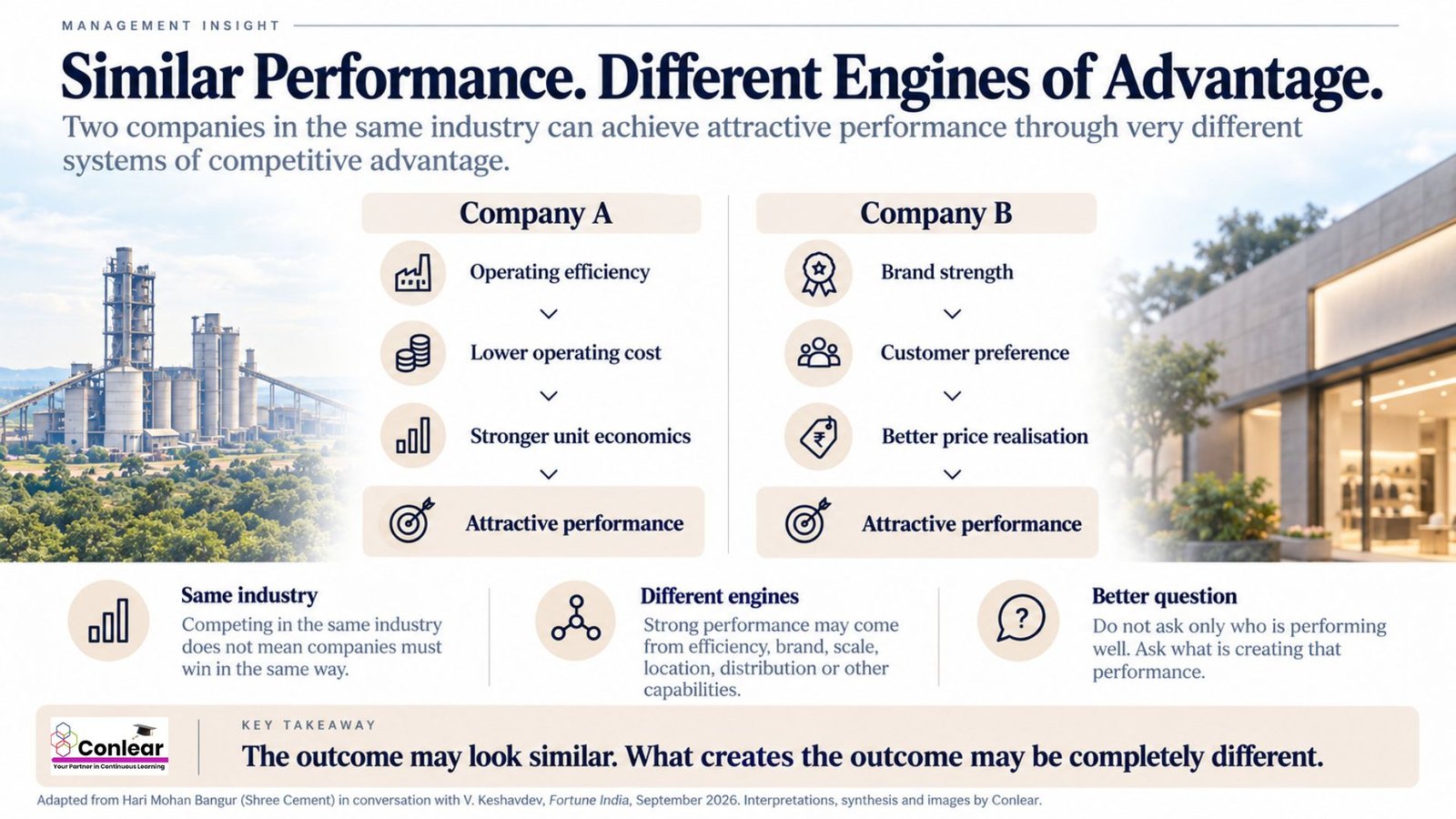
The products may be broadly comparable, yet the economic systems behind them can be quite different. One company may create strong profitability through lower operating costs and disciplined execution. Another may achieve equally attractive results because customers value its brand and are willing to pay more. A third may benefit from better market access, scale or distribution strength.
This is why competitive analysis should go beyond visible actions such as advertising campaigns, acquisitions, product launches or capacity expansion. These actions may only be the outward expression of capabilities that have been built over several years.
A company may be able to invest aggressively in branding because it already has customer trust, product credibility and strong channel relationships. Another may expand capacity successfully because it has better locations, lower project costs or stronger execution capability.
The useful question, therefore, is not simply, “What is the competitor doing?” It is, “What is actually creating value for that competitor?”
The Source of Advantage Also Reveals the Risk
Understanding the source of advantage becomes even more useful when we look at risk.
A company relying heavily on operating efficiency must continue protecting its cost position. If competitors catch up technologically, input economics change or operating discipline weakens, part of that advantage may disappear.
A company relying more on brand strength faces a different challenge. It must continue maintaining customer preference, trust and perceived value. If customers stop seeing sufficient difference, the premium attached to the brand may weaken.
The same logic applies to other sources of advantage. A company depending on scale has to manage the complexity that comes with scale, while a company growing through acquisitions must be able to integrate the assets it buys. A company depending heavily on distribution must continue protecting its reach and channel relationships.
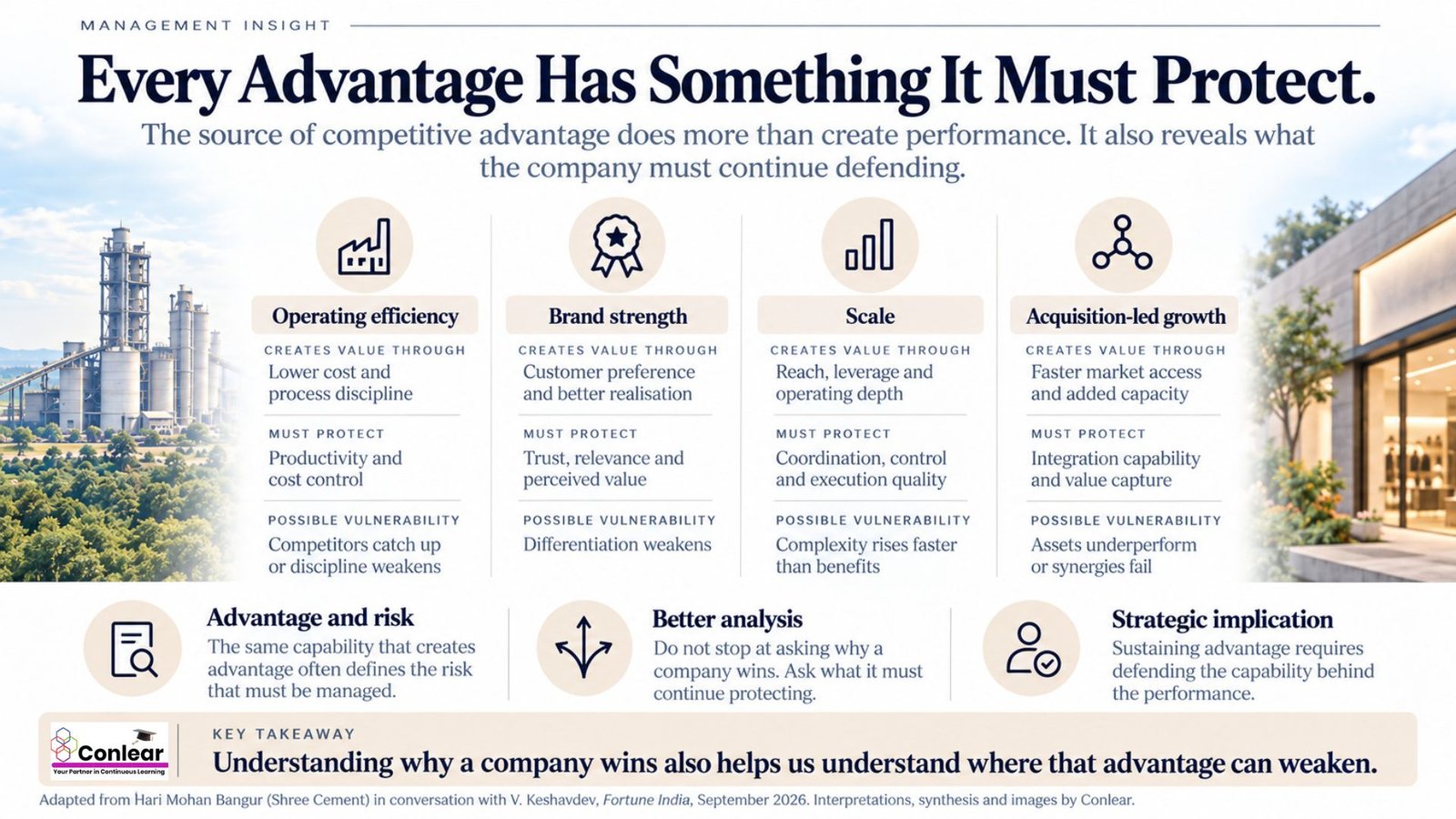
The source of advantage therefore tells us not only why a company is performing well, but also what it must continue protecting in order to sustain that performance.
This is what makes the analysis more useful than simply comparing market share, margins or visible strategic moves.
The Key Take Away
Two companies can operate in the same industry, serve similar customers and report equally attractive performance, yet be winning for completely different reasons.
The real work of strategy is therefore not merely to identify who is winning. It is to understand why they are winning.
Once that becomes clear, an even more important question follows:
Are we building an advantage that fits our own capabilities, or are we trying to reproduce an advantage that works because of somebody else’s capabilities?
That distinction matters because strategy is not only about choosing an attractive direction. It is also about building the capabilities that make that direction economically valuable.
Perhaps this is the more useful way to study competitors. We should certainly observe what they are doing, but we should look beneath those actions and understand the system of capabilities, assets and choices that is producing the result.
Because two companies can perform equally well in the same industry while relying on very different sources of advantage.
Source and attribution
This article-based insight draws on Hari Mohan Bangur’s interview with V. Keshavdev in Fortune India, September 2026. Bangur’s observations on operating efficiency, brand-building and the validity of different strategic paths are drawn from the original interview.
The broader interpretation and synthesis presented here are by Conlear: companies in the same industry can succeed through different systems of competitive advantage, and understanding the source of performance may be more useful than comparing outcomes alone.